



CNC Operator Salary Netherlands
- Home
- Salary Guides
- CNC Operator Salary Netherlands
CNC operators in the Netherlands typically earn €14.71–€22.00 gross per hour, which works out to roughly €2,550–€3,800 gross per month on a 40-hour week. The average sits around €35,000–€40,000 gross per year. Entry-level pay starts at the Dutch statutory minimum wage (€14.71/hour in 2026); experienced operators with specialist machine or programming skills can earn well above €22/hour.
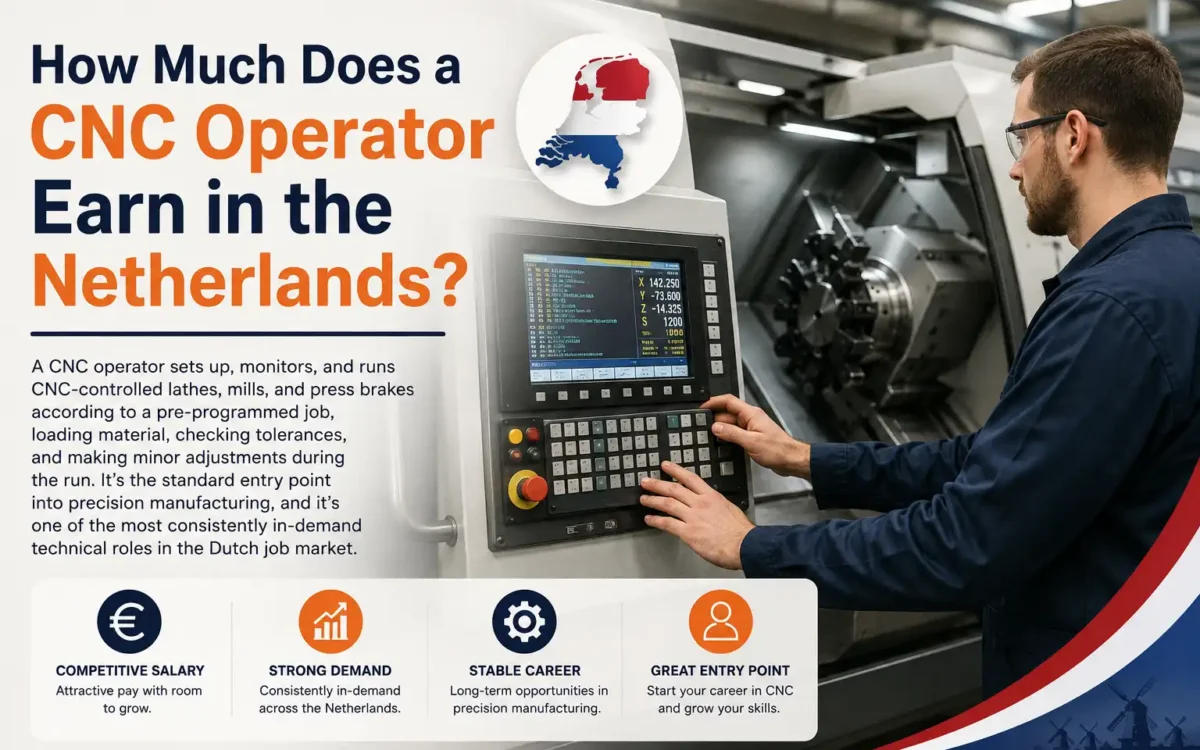
How Much Does a CNC Operator Earn in the Netherlands?
A CNC operator sets up, monitors, and runs CNC-controlled lathes, mills, and press brakes according to a pre-programmed job, loading material, checking tolerances, and making minor adjustments during the run. It’s the standard entry point into precision manufacturing, and it’s one of the most consistently in-demand technical roles in the Dutch job market.
| Pay period | Gross range |
|---|---|
| Hourly | €14.71 – €22.00 |
| Monthly (40h/week) | €2,550 – €3,800 |
| Annual (base, excl. holiday allowance) | €30,000 – €46,000 |
CNC Operator Salary by Experience Level
| Experience | Gross per hour | Gross per month | Gross per year |
|---|---|---|---|
| Entry-level (0–2 years) | €14.71 – €16.50 | €2,550 – €2,860 | €30,000 – €34,000 |
| Mid-level (2–5 years) | €16.50 – €19.00 | €2,860 – €3,290 | €34,000 – €40,000 |
| Experienced (5+ years) | €19.00 – €22.00 | €3,290 – €3,810 | €40,000 – €46,000 |
Operators who move into setup, multi-machine oversight, or 5-axis work sit at the top of, or above this range.
CNC Operator Salary by Region
Pay tracks where the manufacturing actually is:
| Region | Pay level | Why |
|---|---|---|
| Eindhoven & North Brabant | Highest | Semiconductor and high-tech supply chain |
| Rotterdam & South Holland | Highest | Shipbuilding, offshore, heavy industry |
| Zeeland | High | Steel fabrication and process industry |
| Tilburg / Breda area | High | Automotive and general manufacturing |
| Limburg | Average | Automotive and general metalwork |
| Gelderland / Overijssel | Average | Agricultural equipment, lighter CNC work |
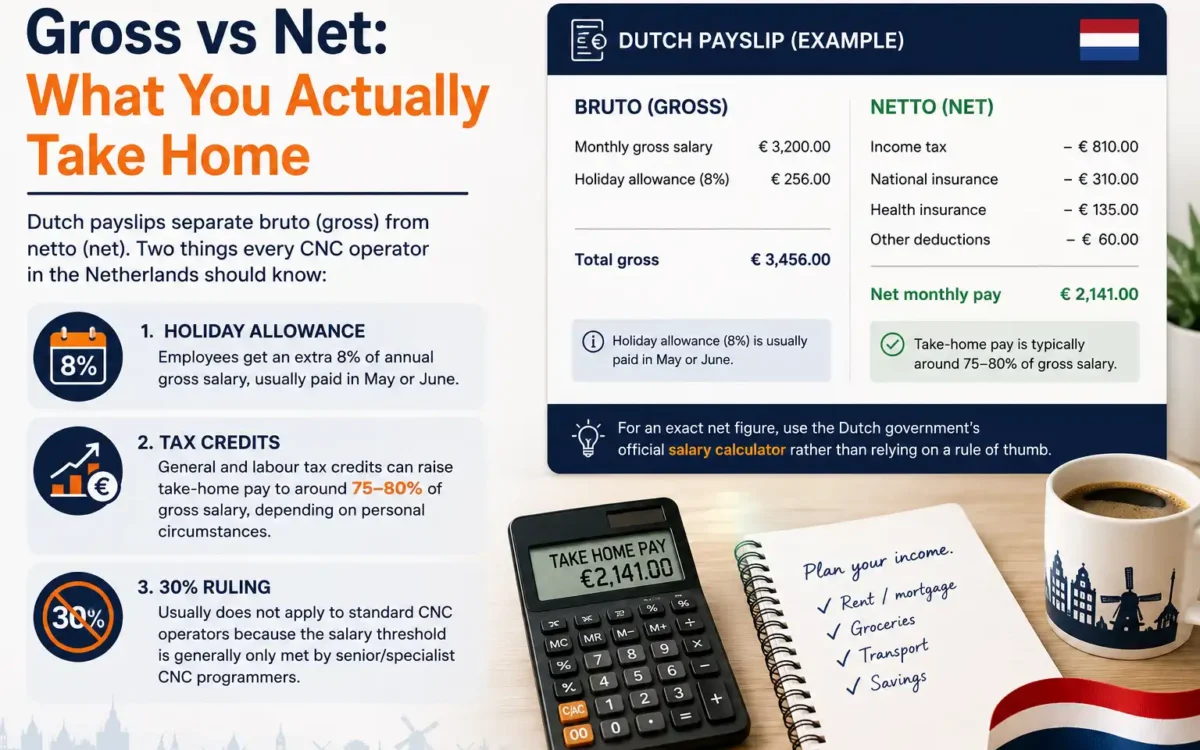
Gross vs Net: What You Actually Take Home
Dutch payslips separate bruto (gross) from netto (net). Two things every CNC operator in the Netherlands should know:
- Holiday allowance: Employees get an extra 8% of annual gross salary, usually paid in May or June.
- Tax credits: General and labour tax credits can raise take-home pay to around 75–80% of gross salary, depending on personal circumstances.
- 30% ruling: Usually does not apply to standard CNC operators because the salary threshold is generally only met by senior/specialist CNC programmers.
For an exact net figure, use the Dutch government’s official salary calculator rather than relying on a rule of thumb.
What Affects CNC Operator Pay in the Netherlands?
- Experience and independence — running a pre-set program pays less than setting up the machine yourself
- Control system expertise — Fanuc, Siemens Sinumerik, Heidenhain, Okuma OSP, and Mazak are the systems that come up most in Dutch job listings; fluency in more than one is worth more
- Machine type — 5-axis milling and multi-axis turning command a premium over standard 3-axis work
- Industry — high-tech/semiconductor supply chain work tends to pay more than general fabrication
- Certifications — a VCA safety certificate and a recognised vocational (MBO) qualification both help
- Shift work — evening, night, and weekend shifts typically pay 120–150% of the standard rate
- Contract type — temporary agency roles often bundle housing and a higher net rate; permanent/direct-employer roles usually offer stronger long-term benefits and job security
CNC Operator vs Other CNC Roles
| Role | Typical gross/month |
|---|---|
| CNC Operator | €2,550 – €3,800 |
| CNC Turner | €2,850 – €4,300 |
| CNC Miller | €2,850 – €4,300 |
| CNC Setter / CAD-CAM Programmer | €3,700 – €5,700+ |
Turners, millers, and programmers all build on the operator role with more setup responsibility or programming skill — a natural progression path if you’re starting as an operator.
Benefits Beyond Base Salary
- 8% annual holiday allowance (legal minimum)
- Pension contributions from your employer
- Travel allowance — commonly €0.21/km for commutes over 10 km
- Mandatory health insurance (often subsidised or arranged via the employer/agency)
- For international hires, many agencies include furnished accommodation near the workplace
- Overtime and shift premiums
Netherlands vs Other Countries
At the level of the overall economy, the Netherlands is consistently one of the higher-paying countries in Western Europe, running close to Belgium and ahead of Germany on average gross wages — though for a specific trade like CNC machining, actual pay depends far more on regional industry concentration (like the Brabant high-tech cluster) than on the national average. For workers relocating from elsewhere in the EU, Dutch CNC pay is generally attractive relative to Southern and Eastern Europe, and competitive with — though not always higher than — Germany.
How to Become a CNC Operator in the Netherlands
Most operators come in through an MBO vocational qualification (levels 2–3) in mechanical/precision engineering, though on-the-job training is a common route for career switchers and international candidates with relevant experience. A VCA safety certificate is frequently requested. English is usually enough to get started on the shop floor; Dutch becomes more important as you move toward setter, team lead, or programmer roles.
Find CNC Operator Jobs in the Netherlands
Ready to see what’s actually available?
Frequently Asked Questions
What is the average CNC operator salary in the Netherlands?
Around €35,000–€40,000 gross per year (roughly €17–€19 gross per hour), though it ranges from about €30,000 for entry-level operators to €46,000+ for experienced ones.
How much does a CNC operator earn per hour in the Netherlands?
Typically between €14.71 (the 2026 statutory minimum wage) and €22.00 gross per hour, depending on experience and machine complexity.
Is CNC operator a well-paid job in the Netherlands?
Yes, relative to many entry-level technical roles — pay starts near minimum wage but rises quickly with experience, and the persistent shortage of skilled operators gives workers real negotiating leverage.
Do CNC operators in the Netherlands need to speak Dutch?
Not usually at entry level — English is widely used on Dutch shop floors. Dutch becomes more valuable for progressing into setter, team lead, or programming roles.
How can a CNC operator increase their salary in the Netherlands?
Learn a second control system (Fanuc, Siemens, Heidenhain), move into machine setup rather than run-only work, pursue 5-axis experience, or work toward a CAD/CAM programming qualification.
Note: Salary estimates are based on aggregated 2026 data from ERI Economic Research Institute, Salary.com, Glassdoor, the Dutch government’s official minimum wage figures, and current Dutch recruitment-market job postings. Figures are gross indicative ranges and will vary by employer, contract, and negotiation.