



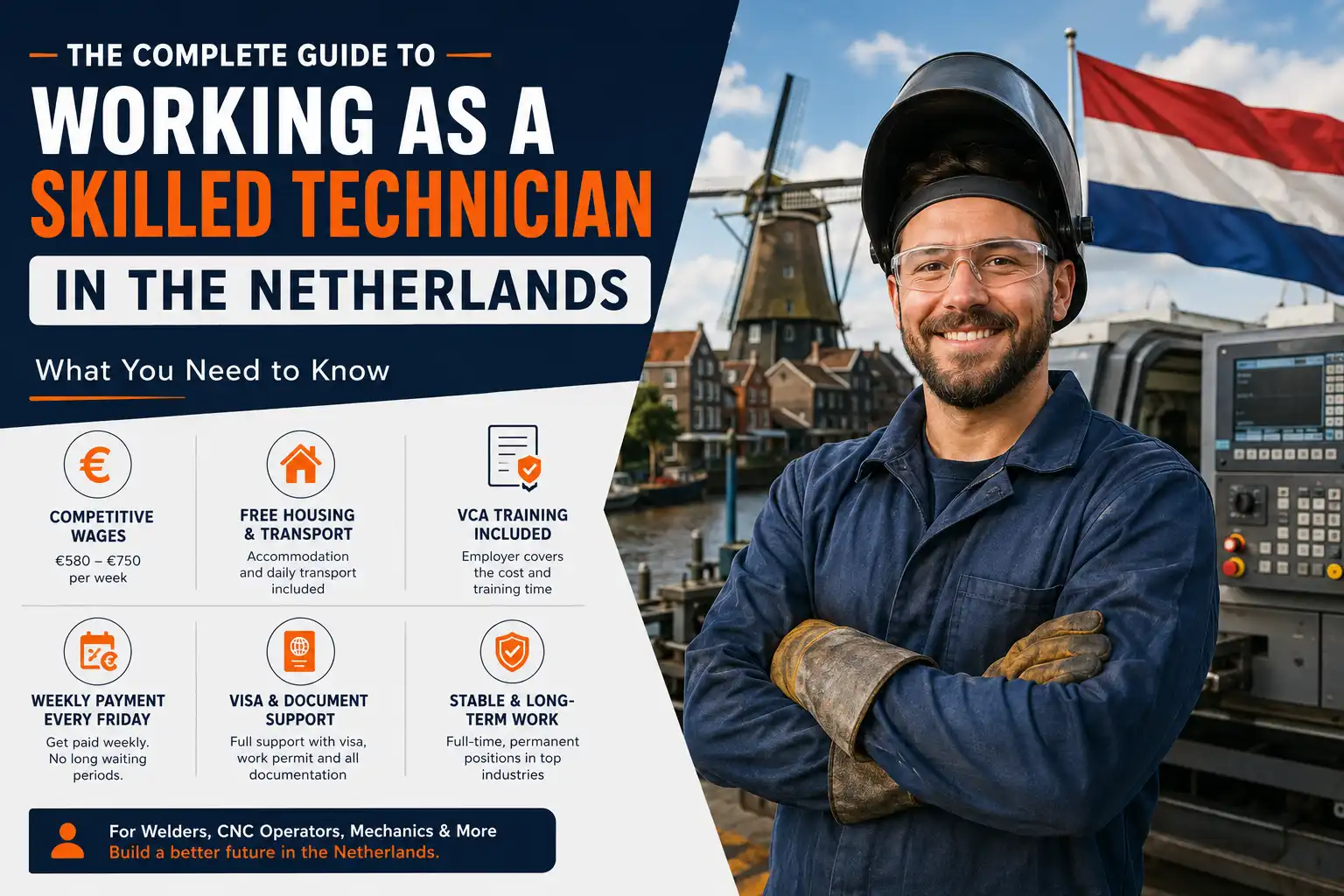
If you’re a skilled technician considering a career move, the Netherlands is one of Europe’s most attractive destinations for technical professionals and craftspeople. With a booming industrial sector, competitive wages, and comprehensive support for international workers, the Netherlands offers genuine opportunities for welders, CNC operators, mechanics, and construction specialists.
But navigating the process of working abroad can feel overwhelming. This guide breaks down everything you need to know about finding skilled technical jobs in the Netherlands, from visa requirements to daily life in Dutch cities.
Why the Netherlands? The Reality for Skilled Technical Workers
The Dutch economy is built on precision, engineering, and craftsmanship. Whether it’s shipbuilding, automotive manufacturing, or advanced CNC machining, the technical trades in the Netherlands are in high demand and paying significantly better than many other European countries.
Here’s what makes it attractive:
Competitive Wages for Technical Skills. A CNC operator or welder in the Netherlands can earn €580–€750 per week, often with overtime opportunities pushing earnings even higher. For comparison, this significantly exceeds typical wages in Eastern Europe, Romania, Poland, and even parts of Western Europe.
Stable, Long-Term Work. Most employers hiring international technicians are offering full-time, permanent positions. The construction and manufacturing sectors have consistent demand throughout the year, meaning you’re not competing for seasonal work. This stability matters when you’re relocating your life.
Free Housing and Transport. Unlike many countries where you’re scrambling to find accommodation on low wages, most technical jobs in the Netherlands through recruitment platforms include free housing and daily transport to worksites. This removes the single biggest expense for relocating workers.
Legal Support and Structure. The Netherlands has transparent employment law and employment contracts are serious matters. You’re protected by Dutch labor law, which means minimum wage guarantees, clear working hours, and legitimate dispute resolution.
The Core Benefits: What Sets Dutch Technical Employers Apart
When you’re considering working in the Netherlands, the support structure is where it gets real. Top employers don’t just hire, they invest in their international workforce.
Housing Provided: Free accommodation isn’t luxury housing, but it’s clean, safe, and conveniently located. For welders and CNC operators relocating internationally, this means you arrive and have a place to sleep immediately. No scrambling with landlords, no deposits, no confusion. Many employers provide housing within walking distance or a quick bus ride from the worksite.
Transport Arranged: Daily transport to the worksite is handled. You don’t navigate unfamiliar roads or figure out the Dutch public transport system on your first week. A vehicle picks you up, drops you off. This matters when you’re adjusting to a new country and job simultaneously.
VCA Training Included: VCA certification (Veiligheidscultuur Arbeidsomstandigheden, Safety Culture in the Workplace) is mandatory for most technical roles in the Netherlands. The good news? Your employer covers the cost and training time. This certification isn’t just paperwork, it’s internationally recognized and boosts your employability across Europe.
Weekly Payment Every Friday: No waiting 30 days for your first paycheck. Established technical recruitment platforms in the Netherlands pay weekly. For workers relocating from lower-wage countries, this cash flow matters enormously. You can send money home regularly and maintain stability.
Visa and Documentation Support: International relocation involves paperwork. Legitimate employers handle visa applications, work permits, and regulatory documentation. You’re not navigating Dutch immigration alone.
Which Technical Roles Are Most In-Demand?
If you’re considering skilled jobs in the Netherlands, understanding where the real opportunities are helps you position yourself strategically.
CNC Operators and Machinists: Advanced manufacturing requires precision. CNC machining roles span milling, turning, and all-round operations. With experience on CNC equipment, you’re employable immediately. Wages typically range €580–€700 per week, with opportunities for advancement into supervisory roles.
Welding Specialists:
The Netherlands has active welding jobs across multiple specializations:
– MIG/MAG welding for general fabrication and construction
– TIG welding for stainless steel and specialized work
– Ship welding (particularly in Rotterdam and shipbuilding centers)
Welders consistently earn €610–€650+ per week because specialized welding commands premium rates.
Construction and Building Trades
Construction jobs in the Netherlands include plumbers, electricians, carpenters, and general laborers. These roles often connect to major infrastructure projects and are among the most stable technically.
Automotive Mechanics
The automotive sector in the Netherlands supports both new manufacturing and repair/maintenance. If you’re a qualified mechanic, employers are actively recruiting internationally.
Electrical and Automation Technicians
As manufacturing becomes increasingly automated, electrical technicians who can troubleshoot PLC systems, control panels, and automation equipment are in serious demand.
The Realistic Timeline: From Application to First Paycheck
Here’s what actually happens when you apply for a technical job in the Netherlands:
Week 1-2: You submit your application through the recruitment platform. Legitimate employers respond within 3-5 days. Initial screening is usually phone or video interview, straightforward questions about experience, certifications, and availability.
Week 2-3: If they’re interested, you’ll complete a formal interview. They’ll confirm housing, transport arrangements, and start date. Visa requirements are discussed at this stage. For EU citizens, the process is faster. Non-EU citizens typically need 4-8 weeks for work permit processing.
Week 3-6: Paperwork processing. Your employer submits visa documentation. You gather required documents (passport, proof of employment, housing confirmation). This isn’t instant, but legitimate companies manage the process professionally.
Week 6-8: You receive visa approval (if applicable). You arrange travel. Many employers offer travel cost reimbursement or advance payment to cover flights and relocation expenses.
Week 8+: You arrive in the Netherlands, meet your employer, move into provided housing, and start work. Your first paycheck arrives that Friday or the following Friday.
The total timeline from application to first paycheck is typically 8-12 weeks for non-EU workers, and 4-6 weeks for EU citizens. This isn’t immediate, but it’s structured and predictable.
Understanding Dutch Work Culture and Daily Life
Working in the Netherlands means adapting to Dutch professional norms, which are genuinely different from what many international workers expect.
Direct Communication: Dutch professionals are famously direct. This isn’t rudeness, it’s efficiency. Your supervisor will give you straightforward feedback. There’s minimal hierarchy theater. You speak up in meetings. This takes adjustment if you’re from cultures with more formal hierarchies, but most workers find it refreshing.
Punctuality and Reliability: The stereotype is accurate. Dutch employers expect you at your start time, reliably. This is non-negotiable. If you’re normally 15 minutes late to work, that won’t fly. Being punctual is foundational to Dutch work culture.
Safety-First Mentality: Dutch worksites are rigorous about safety protocols. VCA certification reflects this. Hard hats, safety shoes, and equipment checks aren’t optional. This protects you and everyone around you.
Work-Life Balance: Conversely, the Dutch prioritize personal time. Working past 5 PM regularly is unusual. Weekends are sacred. Your employer respects this boundary, and you should too.
Language Considerations: English is widely spoken in major cities and among younger professionals. However, learning basic Dutch is genuinely appreciated and makes daily life easier. Simple survival phrases, ordering food, asking directions, basic greetings, take a week to absorb.
Cost of Living: Budgeting Your Dutch Income
Your €600–€700 weekly wage gives you financial flexibility that’s actually significant once you understand Dutch costs.
Housing: Covered by your employer. But if you want to rent privately later, expect €400–€600/month for basic accommodation outside major city centers.
Food: Supermarkets like Lidl and Jumbo are affordable. A weekly grocery budget of €40–€60 covers basics. Dining out is expensive; a casual meal costs €12–€18.
Transport: Public transport passes (MijnOV) cost roughly €80–€120/month for regional access. Many areas offer employer subsidies.
Phone/Internet: €20–€40/month for decent mobile plans and home internet.
Entertainment: Modest costs. Gym memberships are €30–€50/month. Cinema tickets cost €10–€12.
Clothing and Necessities: Competitively priced. Most workers find the cost of living manageable once housing is covered.
Financial Reality: After housing (free), transport, and food, a weekly earner is banking €300–€400+ weekly. Over a year, that’s €15,000–€20,000+ after expenses. Many international workers use this income to support families back home, build savings, or fund further career development.
Red Flags: Identifying Legitimate vs. Fraudulent Opportunities
The demand for skilled technical workers in the Netherlands has unfortunately attracted bad actors. Protect yourself by recognizing warning signs.
Legitimate employers:
– Have established websites and verifiable company information
– Are transparent about housing, transport, and salary before interviews
– Never ask for upfront fees (visa fees, processing fees, housing deposits)
– Provide written employment contracts in English
– Respond professionally to inquiries
– Offer references from other international workers
Red flags, avoid these situations:
– Requests for “visa processing fees” or “registration fees” before employment
– Vague descriptions of housing or transport arrangements
– Pressure to decide immediately without seeing contracts
– Inability to verify company information or provide references
– Job posts with grammar errors or unprofessional presentation
– Requests for your passport or sensitive documents before contract signing
Reality check: Legitimate technical recruitment in the Netherlands doesn’t require you to pay anything. Employers pay recruitment agencies or platforms. You never pay. If someone’s asking for money, it’s fraud.
Advancement and Long-Term Career Paths
Starting as a technician is just the beginning. The Netherlands offers genuine career progression.
Supervisory Roles: After 1-2 years of solid performance, many CNC operators and welders move into team lead or supervisory positions. Dutch companies value demonstrated reliability and technical knowledge.
Specialization: If you’re a generalist CNC operator, you can specialize in complex operations (5-axis programming, advanced materials) and command higher wages. Specialized welders (underwater welding, shipbuilding-specific techniques) earn significantly more.
Trades Training and Certifications: The Netherlands supports continuous professional development. Many employers reimburse training costs for relevant certifications and advanced qualifications.
Permanent Residency and Settlement: If you perform well and want to stay, the Netherlands offers pathways to long-term residence. After 5 years of continuous employment and meeting integration requirements, you can apply for permanent residency.
Your Next Step: How to Actually Apply
Ready to pursue technical jobs in the Netherlands?
Step 1: Assess Your Qualifications
Document your experience clearly. List certifications, years in your trade, equipment experience, and any specialized skills. Most recruiters want 2+ years of relevant experience.
Step 2: Prepare Documentation
Gather a clean copy of your passport, professional references, and certification documents (welding certifications, CNC training, safety training, VCA if you have it). Translations of non-English documents are often required.
Step 3: Research Legitimate Platforms
Use established recruitment platforms specializing in **Dutch technical jobs**. Look for companies with verifiable histories, professional websites, and transparent communication.
Step 4: Apply Strategically
Apply to roles matching your experience level. Be specific in your application. Mention your exact experience with equipment types, materials, and certifications. Generic applications get filtered out.
Step 5: Prepare for Interviews
Research Dutch companies and industries. Prepare to explain your experience clearly and concisely. The Dutch appreciate specificity and evidence. “I’m good at welding” doesn’t work. “I’ve completed 500+ TIG welds on stainless steel in industrial settings” does.
Step 6: Understand Contract Terms
Before accepting an offer, review the employment contract carefully. Ensure housing details, transport arrangements, wages, start date, and contract duration are explicitly stated. Ask questions about anything unclear.
The Bottom Line: Is Working in the Netherlands Right for You?
The Netherlands is genuinely attractive for skilled technical workers, particularly those from lower-wage European countries or those seeking stable, well-compensated work.
It makes sense if:
– You have 2+ years of documented experience in your trade
– You’re comfortable relocating internationally
– You want stable, long-term employment
– You’re motivated by competitive wages and professional development
– You can commit to at least 12 months away from home
It might not be the best fit if:
– You’re unwilling to adapt to Dutch work culture
– You require immediate family proximity
– You’re seeking short-term contract work rather than permanent roles
– You don’t speak English (though you can learn on the job)
Final Thoughts
Working in the Netherlands as a skilled technician is achievable and worthwhile. The combination of fair wages, employer support (housing, transport, training), and career stability genuinely differentiates Dutch opportunities from many other European markets.
The process is structured, transparent, and achievable. Your investment is your time during the application and visa process—not money. Legitimate employers handle the complexity because they want reliable, skilled workers.
If you’ve got the technical skills, willingness to relocate, and commitment to professional work, the Netherlands is actively recruiting. The next step is identifying the right opportunity and applying.


Leon is the owner and content writer at Craftmen Jobs. He writes about skilled trades, technical careers, job opportunities, and employment in the Netherlands, helping skilled workers find reliable career opportunities.